The clip started with me beat on a couch.
Sunday evening, April 12, 2026. I was in my atelier in Berlin, sitting and not working. One of those days where you feel the energy drain from your body. I hadn't been very active on social media for weeks — just the usual background stuff: coding, trying new textures on AI videos, running a few 3D experiments nobody would see. Nothing was cooking. Nothing was drawing me in.
And yet the news of the week was working inside me.
For weeks, the Iranians had been blocking the Strait of Hormuz — the narrow passage at the mouth of the Persian Gulf where a third of the world's seaborne oil has to physically pass through. They'd been stopping ships, charging tolls, threatening to fully close it. Global shipping insurance was spiking. Oil prices wobbling. Currencies moving. Everyone who tracks macro markets was starting to watch the water. The idea that a narrow two-nautical-mile channel in the Gulf could tilt the whole global economy is always technically true; it only feels true when the narrowness starts exerting itself.
And then Trump. Meme president Donald Trump. Who for the purposes of this book is a character as much as he's a man — just as he was in his own first term, his second, and however many he's going to claim before he's done. Trump had just announced, with his signature escalation rhetoric, that he was going to block the blockade. American Navy would physically interdict Iranian ports. Reciprocal closure. The joke writing itself before anyone got to the joke.
I've thought about this moment a lot since. I don't want to go into detail about Trump's extra-special strategy with exaggeration and getting the world's attention — we've all read enough of that — but he'd done it again. Blocking the blockade. It sounds as if a child is speaking. Or maybe a man with an IQ of 160. I don't know. It's either 60 or 160.
I've witnessed too many events and too many meme opportunities over the past twenty years to let a block-the-blockade moment go. The phrase has everything: rhyme structure, absurd logic, schoolyard energy, and underneath all of it, actual dead children from airstrikes at a school I won't name in this chapter because I'll spend a whole chapter on it later and don't want to spend the name twice. The subject of the joke is not a joke. The joke is the joke. Those are two different things, and a meme lord who doesn't know the difference will wreck his career inside a month.
The rhyme
It came to me as a rhyme first.
"Blockade, blockade…"
Which, the second I heard it in my own head — maybe I was at the sink, I don't remember — rhymed with something older. "Voyage, voyage." The 1986 song by the French artist Desireless. A track I'd known my whole adult life. A track a whole generation of Europeans who were kids in the 80s has lodged somewhere between their subconscious and their nostalgia reflex. Synth-pop, cold-war palette, a woman with a short dark haircut staring into a wind machine. Famous enough to remember. Obscure enough in 2026 to catch the listener off guard.
And here's what song-spoof writers know that regular writers don't: songs always work. Songs beat prose. Especially songs from your youth. Especially songs you'd half-forgotten. Especially the catchy ones. Music grabs the limbic brain faster than sentences do, and once the limbic brain is grabbed, the intellect is playing catch-up for the rest of the experience. That's not a theory I hold. It's a theory I've tested — hundreds of times, maybe thousands, across ten years of making German song-spoofs for a living.
Because that's what I do, for the record. A whole decade of this. Song-spoofs about German politics, German society, COVID rules, speech codes, the nightly news — an endless parade of small crises each of which you'd forget the following week. People call me Germany's Weird Al. It's a compliment with some bite to it: in Germany, comparing a satirist to an American icon is usually the moment you notice the country doesn't have an equivalent of its own. But okay. German Weird Al. Hundreds, maybe thousands of little clips. Millions of views inside Germany, almost no visibility outside of it, which is the permanent curse of working in German.
The rhyme arriving — Blockade, Blockade / Voyage, Voyage — meant the song-writing part of my brain had already been at work while the tired part of my brain was on the couch. That's how this works. You sit in the news long enough that your pattern-recognition starts producing outputs you didn't ask for. Some people call this muscle memory. Some people call it creativity. I just call it auto-engage. When a rhyme shows up, I don't have the option of ignoring it. I have the option of writing it down.
So I wrote it down.
And then — the rules.
I don't have much time. I can't make a full song. I need forty or fifty seconds with a short verse and a punchy hook. Don't bore people. Entertain them instantly. Capture the zeitgeist. Twist reality. Make it better. Make it awesome. Make it shareable. Make it legendary.
That last word is the one I notice. Legendary. Not good. Not correct. Not true. Legendary. Meaning: a thing people will still remember after the week is over. Meaning: more than the moment. Meaning: a song that is going to take someone's attention in a crowded algorithmic feed and hold it long enough that they share it with another person. Those are the meme rules. They are the rules of our era's attention economy in the compressed form I've been teaching myself for a decade.
Legendary first. Everything else serves legendary.
The toolchain
So what does it actually take, in April 2026, to make a synth-pop Donald Trump music video in an afternoon?
I get asked this now, in interviews that are still happening this week, and the asking is itself interesting. Five years ago nobody would have asked because nobody would have believed it was possible. Seven years ago nobody would have asked because nobody would have imagined a world where it was relevant. Here in 2026, everyone wants the recipe.
Here is the recipe.
Image generation. I fired up Nano Banana Pro on a platform called Higgsfield. Nano Banana Pro is Google's frontier image model in April 2026 — the tool that replaced the tool that replaced the tool. Higgsfield wraps it with better UI and faster throughput. You don't need a reference image for Trump anymore; the model has Trump the way it has the Eiffel Tower. He's a known token. My prompt was — and I'm quoting my own prompt here, because it's the prompt, not a simplified version:
Give me a 3×3 grid with 9 different variations of Trump looking like a 1980s French synth-pop singer at a keyboard.
Ran it three or four times. Got twenty or thirty variants back. The one I picked was the middle-right panel: curly mullet, multicolored geometric jacket, Trump sitting at a vintage keyboard.
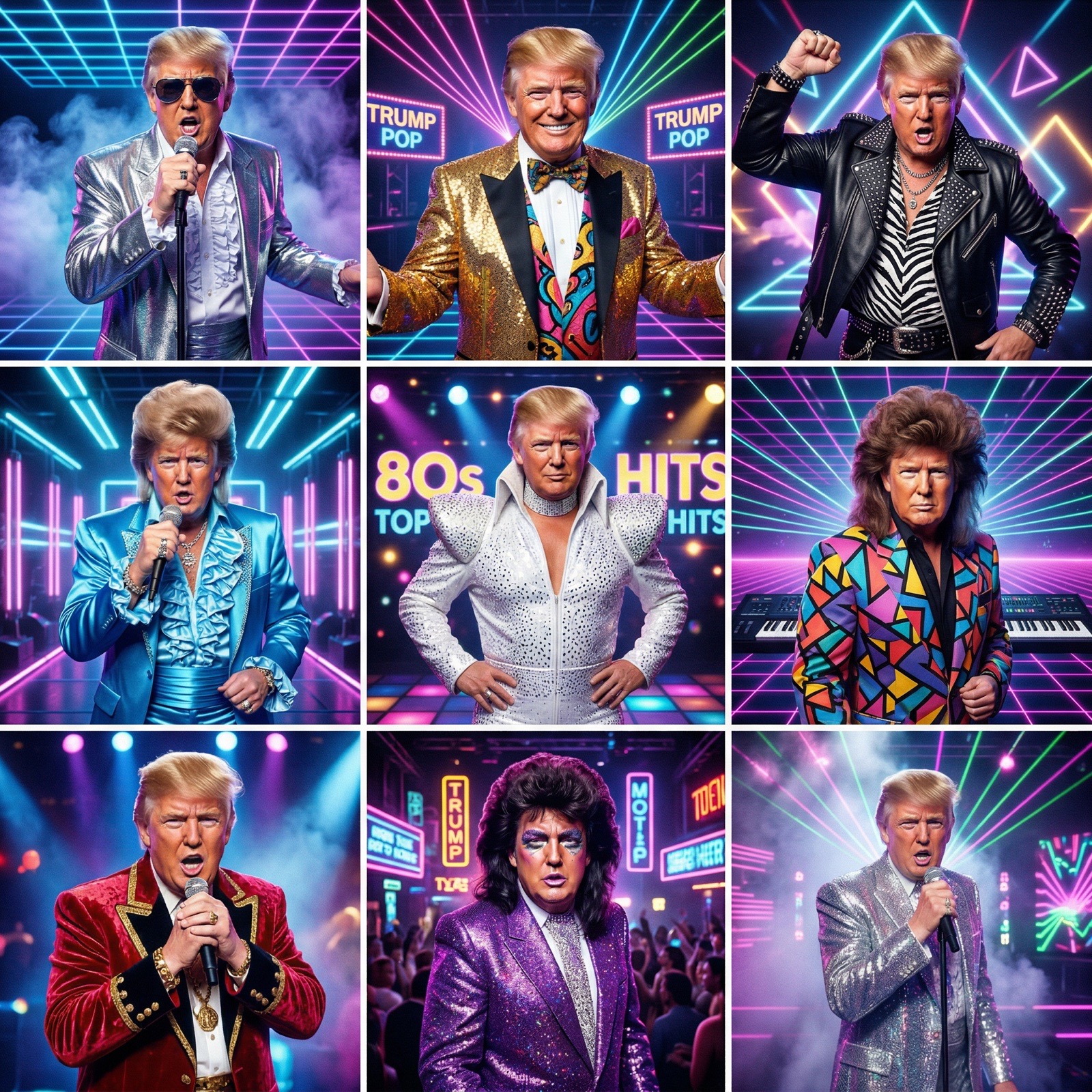
And here is where the first small miracle happened. The model gave him a Yamaha DX7. If you don't know what a DX7 is, you aren't supposed to — it's a synthesizer from the early 80s, the one actually used on the original Voyage Voyage track and about a thousand other era-defining records. I didn't prompt for a DX7. I just asked for a keyboard. The model — which knows, somehow, which synthesizer belongs to which era of pop music, because the training data apparently contains enough 80s synth-pop discourse to encode that mapping — gave me the correct one unprompted.
A week later there would be a whole sub-thread of synthesizer nerds on Instagram arguing about why the rendered DX7 was missing a specific button. These are the commenters the AI era has forged: people who can identify hardware from pixel artifacts on a synth-pop Trump diss track. I love them. I won't tell them publicly; I'd like to preserve the love.
Video. The still image went into Grok Imagine for a quick animation gut-check — does the character move in ways a person would sing? Then I moved to Kling 3.0 and Veo 3.1 for the actual shots. You don't use one video model in 2026. You use three or four and blend the outputs. Each model has its own flavor. Kling is better at fluid movement. Veo is better at consistency across shots. Grok gives you multi-shot compositions faster. I've developed an internal shorthand for which tool does which job, the way a cook develops a sense of which knife to use for which vegetable.
This is the part where I get into flow, where my brain stops narrating what I'm doing and starts just doing. Twenty, thirty iterations of Trump playing synth. Tiny variations of head tilt, keyboard angle, timing of a blink. At some point — usually earlier than you'd expect — you can feel it clicking. It works. That's the internal signal. And once the signal lands, I know I have a clip.
A note on speed, because people ask. The whole video step, end to end, is maybe two hours. Three years ago, this was impossible. Two years ago, it was the kind of thing that took a weekend. One year ago, it was most of a day. Right now — in the window where I am writing this book — it's an afternoon. In eighteen months it will be a matter of minutes. That curve isn't stopping.
Sound. I'm a trained singer. Soul, country, R&B, pop, singer-songwriter. Song-spoofs aren't just a format choice for me; they're a craft I actually know. And for Blockade the question was: how does Trump sing this? Not how do I sing this. How does he sing this.
The answer, after experimentation, was: a little crooked, kind of loveable, kind of goofy. Word-for-word like a rapper was too deliberate. Auto-tuned to perfection was too smooth. Too-good was too-American-pop. The sweet spot was slightly off, slightly behind the beat, slightly unresolved. In a later chapter I'll tell you that this is a principle I have a whole name for — imperfection as perfection, the deliberate-degradation move — but for now just hold the thought: Trump's vocal needed to be less good than I could make it, in a specific way, on purpose.
Then the voice filter. There are several online. By 2025 most of the mainstream platforms had rate-limited or outright banned politician voices. By 2026 you could still find what you needed if you knew where to look, or you ran a local model. I won't teach you how. It's not hard and the book isn't a tutorial. I ran my own singing through a voice filter tuned to Trump-vocal, laid it over the original Voyage Voyage instrumental — still copyright-live, by the way, and we'll talk about that — and the sound side was done.
Lip sync is where the safety measures kick in. It's the point in the production where AI becomes potentially deceptive, because once a character's lips actually move with the words, a casual viewer can be fooled. The platforms, the labs, and the regulators all know this. So do I. My defense on this particular clip is easy and I will state it cleanly: it's not about faking, it's about entertaining. Trump looks younger than the real Trump. He has a curly mullet and a geometric jacket and a keyboard and the entire production aesthetic reads obviously manipulated before a single lip movement happens. The clip marks itself as satire from the first frame. That's the ethical line for me, and I won't cross it. Other people will. We'll get to that.
Post-production. Edgier-look filter. VHS glitch effects. A color grade that shifts everything toward the late-cold-war television palette. A small animated 80s robot added in a corner for comic punctuation. A vocoder voice for the robot's one line. The robot is not load-bearing but it's mine. I keep it.
End of production. The whole thing is one minute and four seconds long. Plays clean on any platform.
The pause
Then I stopped.
This is the paragraph I want you to read twice.
I sat at the desk, looking at the finished file, and I didn't hit publish. Something was missing. Not technically — technically the clip was done. Missing in some other direction. I thought about it.
Is this strong enough?
Is this good for peace?
Is this bad for peace?
Will this spark more hate?
I have to think about these things. I don't wanna just push slop.
I want to pause here for one moment of non-rhetorical honesty, because what I said to myself at that desk on that Sunday evening is almost the same thing everybody keeps accusing AI-era creators of not thinking about. The dominant story about people like me — the story told by critics and professors and newspaper op-ed writers — is that we push buttons and content shoots out and none of us ever stops to ask what the content is for. That story has been told so many times that even some of us have started to believe it about ourselves.
But here's the truth. Sitting at a desk in Berlin with a finished satirical clip about a US-Iran war on my screen, I did stop. I stopped for real. And the question I asked wasn't some polished ethical framework from a seminar on AI safety. It was four words.
Is this good for peace?
I don't have a clean answer to that question. I don't think anyone does. But I have the question, and I asked it, and anyone who claims AI-era creators don't ask it will, from here on out, be inaccurate about at least one of us. That one's on the record now. Let the accusation go bother someone else.
Here's the honest part, though, because the clean version of this story would make me sound more saintly than I was. The Make it legendary engine was running the whole time. Is this good for peace — running. Make it legendary — running. Both drives awake in the same room, arguing with each other, while I sat at the desk deciding. Those two questions weren't sequential. They were simultaneous. A book that tells you otherwise is a book trying to sell you a better version of the author.
After about ten minutes of looking at the clip with both questions in mind, I felt it. Yes, this is lovely. Let's push it.
Except I didn't push it.
I was still tired from the Sunday fatigue that had started the whole thing. Something in my body was still telling me the timing wasn't right. I trust that body signal. It's been right more than wrong for twenty years. I shut everything down. Went to bed.
Monday morning
Woke up fresh.
And here is the thing that meme lords will recognize immediately and readers who don't do this work will think I'm making up. Overnight, asleep, my brain solved the one problem I hadn't consciously known was a problem. Trump's vocal needed exactly one small adjustment — a tiny crook in the delivery of one line, one word stretched a half-beat longer than a trained singer would stretch it. When I woke up, I knew what to do. I fixed it in five minutes. Popped my Snicklink logo into the corner. Uploaded to X, YouTube, Facebook, Instagram, Telegram. Monday, April 13, 2026, around ten o'clock German time.
And then I went to make coffee.
The first hour
The first hour of publishing a meme is a ritual. You watch. You don't do anything else. You don't post a second thing. You don't check email. You watch the numbers.
Here is the heuristic I've trained into my reflexes across a decade of clips: fifty to a hundred shares in the first hour means you have a winner. Not views — shares. Anyone can view a clip. Sharing is a different commitment. A share is someone putting their name on a claim that their audience will also want to see this. Fifty shares in the first hour is the inflection point. A hundred means it's already running without me.
Blockade crossed fifty at about forty minutes. A hundred at about fifty-five. Which meant — before I'd even finished my coffee — the clip had moved past the stage where my own promotion mattered, into the stage where the network was doing the work. Huh. I remember thinking: okay, here we go.
Per-platform, I watched the different audiences wake up. X and Telegram are my political followers; they pick up news-adjacent stuff first. Facebook and Instagram are my funny-and-casual audience; they pick up the music and the production. Different communities following the same creator for different reasons. Blockade hit both at once, which is what you want. The political-joke people were sharing it as commentary. The music people were sharing it as craft. The clip was doing double duty.
Then the geography started moving. German accounts first — this is the standard shape for anything I publish, because my German-language audience is the deepest. Then French accounts picked it up; Voyage Voyage is a French cultural artifact, so the algorithmic bridge lit up easily. Then Indian accounts, which I didn't expect but never really expect. And then somewhere around midday local time, the thing every global-going meme has to do: international accounts start sharing it. Accounts with no obvious connection to me, no connection to Germany, no connection to the French music-cultural layer — just large English-language accounts in the US and UK and Australia seeing a thing and saying this is a thing.
I remember looking at the clock around one p.m. and saying out loud, to nobody in particular, "Aha. My biggest audience is still sleeping. It's only five or six a.m. for them."
The clip was going to hit America while America was in the shower.
By early afternoon, I had over a thousand shares on X. For reference: a thousand shares on X happens maybe once or twice a year for me. It's not daily business. Rare-event territory. And the clip was still climbing — which, at that hour, I registered the way you register good weather. Huh. Nice. Back to scrolling.
The eagle had landed
Then, between six and seven p.m. German time, everything happened at once.
This is the sentence I said to myself at the time, and I'll set it on its own line because it's the line that eventually compressed the whole moment:
The eagle had landed. The flooding gates were open. The Trojan horse had emptied.
Three metaphors in sequence, because one wasn't enough. This is how meme-lord brains talk to themselves when something is getting away from them. The clip was globally viral. Not regionally. Globally. Trending on X in multiple countries. Being stitched and duetted on TikTok. Being cross-posted in Telegram channels I couldn't read because I don't speak the language. Being embedded in Persian-language threads about the war. Being picked up by a chain of accounts I'd never heard of, in languages I couldn't parse, with commentary I couldn't fact-check.
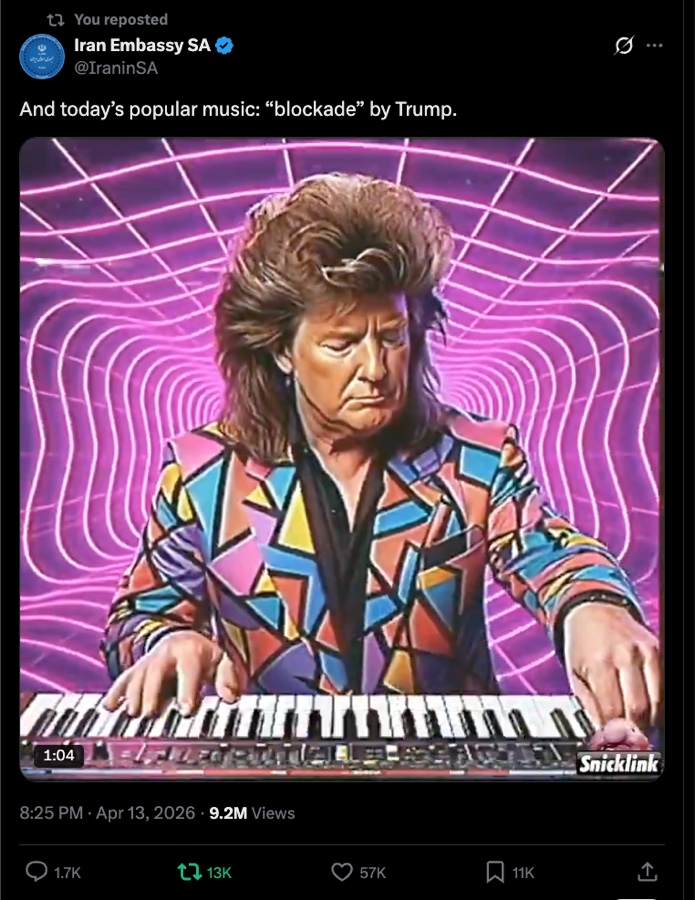
And at 20:25 German time — eight twenty-five in the evening — the Iran Embassy in South Africa reposted it.
Not with attribution. Not linking my original post. Just reposting the video, caption in English:
And today's popular music: 'blockade' by Trump.
That caption is the part of the story that gets lost in the retelling. It's not a neutral repost. It's a bit. The embassy's communications staff — whoever they are, I still don't know; I'll come back to that in a later chapter — dressed the clip in a cover line, implying that Trump is the performer of the song, which would of course be the most publicly self-humiliating thing Trump had ever released if it were actually his. The joke became double-layered the moment the embassy touched it. My joke, made by me, now wearing a second joke pasted on by someone at a foreign ministry using my own clip as the setup for their punchline.
That's when I leaned back from the screen, grinning a little. Surreal and weird. I didn't even know if this was a real Iranian embassy or some little shit poster who'd gotten the account password — except they had the verified checkmark, so apparently yes, real embassy. Important to note, because the narrative tends to flatten this: the clip was already viral by that point, with or without them. The embassy wasn't the trigger. It was the cherry on top of a cake already out of the oven — and that particular cherry tasted unusual. The clip wasn't mine anymore. That wasn't a loss. It meant the thing had gotten bigger.
The clip had entered a war.
The three narratives
Over the next forty-eight hours, what I watched happen in the comment sections and retweet chains was, I think, actually more interesting than the virality itself. There were three stories unfolding at once, in slightly different places, aimed at different audiences.
First narrative, the loudest: "Oh my god, the Iranians are totally winning this meme war. Look what they did." The clip was being cited all over Persian-language media and Iran-sympathetic accounts as an example of Iranian state-propaganda sophistication. Anti-war analysts and Iran-sympathetic commentators pointed to the embassy repost as proof of a disciplined, coordinated meme strategy. For that audience, the clip was Iranian, produced in Iran, perhaps even by the embassy's own content team, for the specific purpose of humiliating the United States. None of those claims were true. All of them were being repeated.
Second narrative, the meta-one: a community of people — my own community, mostly German, some English-language meme followers — began showing up under the embassy's post in growing numbers, saying "Hey, this is Snicklink's work. A German satirist. Not Iranian." The re-attribution effort was organic. Nobody organized it. It happened the way the internet used to happen, before it was all curated by seven or eight apps. People saw something being mis-attributed and corrected it. Some tagged the embassy. Some linked my original post. The correction chain built its own counter-wave.
Third narrative, delayed by about forty-eight hours, the slowest: the German press began to notice that this was, in fact, one of their own. I saw the first German outlets beginning to piece it together by Tuesday evening. By Wednesday, Der Spiegel had a piece. By Wednesday-Thursday, Berliner Zeitung did. Their framings were strange and are their own separate subject — most of them got the story half-right and the rest of it wrong in interesting ways — but what matters here is that the meta-meta-layer took two full days to catch up with the meta-layer, which itself was two full hours behind the initial viral-layer.
In other words: the fast story was wrong, the medium story was partially right, and the slow story was mostly right, and the gap between those three speeds is the exact amount of time in which world-reputations get made and unmade in 2026.
Publicly visible distribution of views: roughly nine million on the Iran Embassy SA repost. Roughly one million on my original post. Roughly another several million across stitches, re-uploads, mirrors, and assorted pirated re-cuts on TikTok, Instagram Reels, and Chinese and Indian platforms I don't have the tools to measure. My own rough estimate of total worldwide reach, as of this writing, is somewhere over fifty million views. The actual number is higher. I can't prove it. I'm not going to try.
The community response
A word on the comments. I read them. Some of them.
On one end of the spectrum: "Why are you supporting Iranians?" — usually from accounts that had been my German followers for years, reading the embassy repost as evidence that I'd taken a side. I hadn't. The clip was a joke about Trump, and a joke about Trump from a German satirist is the single most culturally unremarkable thing a German satirist can do. I'd been making Trump jokes across both his presidencies. Now suddenly I was working for the Ayatollah, at least according to some of the accounts that had followed me for years. I've served and walked away from half a dozen audiences in twenty years; it's not the first time a bubble has turned. Still, there's something very 2026 about your own community suddenly trying to assign you a foreign policy.
On the other end, kinder: "This is awesome. You are messing with world politics. What if Snicklink brings world peace? :))" — that's a real comment someone left. What if Snicklink brings world peace. Nobody with world-peace ambitions survives a compliment like that with their ego intact. I didn't either. I screenshotted it. I'm keeping it.
In the middle, honest: people arguing about the synth-pop aesthetic, people arguing about the octave I chose for the vocal, people arguing about the DX7's missing button, people arguing with each other about whether the clip was pro-Trump or anti-Trump, people arguing about whether the clip was pro-Iran or anti-Iran. And nearly everyone — this is the thing I want you to notice — laughing together in the same thread even when they disagreed. Pro-Trump accounts laughing at a Trump clip. Anti-Trump accounts laughing at the same Trump clip. Iran-sympathetic accounts laughing. Israel-sympathetic accounts laughing. A thing that is funny across tribal lines is a thing that is doing something tribal lines usually prevent. That's a chapter later in this book too. Hold the thought.
What it actually feels like
I want to close this chapter with the thing I actually feel, because everything else in this book will earn more ground if you understand the emotional register for me in the middle of all of it.
People stole the clip. Dozens of accounts re-uploaded it to their own channels, stripped the logo, monetized the views. Some of them sold merchandise with my song on it. Some of them put it on Spotify under their own name. One of them claimed to have produced it. This is standard for any viral clip in the AI era, and I am not going to spend pages complaining about it.
Here is how I feel about it, word for word, the way I've said it to myself:
The same force that pushes your stuff and gives you access to global reach can also take stuff from you. That's just the deal.
That's not resignation. It's architecture. It's the shape of the system I've chosen to work inside. You cannot have the one without the other. You don't get the nine million Iranian-embassy reposts without also getting the pirated TikTok re-uploads. They are two symptoms of the same condition. You take both or you take neither.
And the condition — the larger condition — is what the rest of this book is about. A condition where a single creator at a desk can enter a war by accident on a Sunday evening around 9 p.m.. A condition where a sovereign state's embassy can take that creator's work and dress it in a new joke without attribution. A condition where five different narratives about the same clip can run in parallel for forty-eight hours before anyone aggregates them. A condition where the fast story is wrong and the slow story is right and the attention economy keeps moving regardless.
I used someone else's work as inspiration. Yes. Now someone else is using it for their cause. Yes. But this is the world. This is art. This is virality.
These are the rules of the meme wars.
I wrote that sentence — the one that eventually gave this book its title — in a voice memo to my own archive, three days after the Iran Embassy SA repost, sitting at the desk in Berlin, scrolling numbers that were still going up. I don't remember what I had for dinner that week. I don't remember who called. I remember writing that sentence down. It was the moment the whole noise of the previous week organized itself into something I could say in one line.
The rest of this book is the long version.